Wish to use one HDMI source to multiple displays? A good HDMI Splitter could just be the right remedy for your needs. They will support all different varieties of HDMI source systems which include Xbox 360 elite, cable set tops, Dvd players, Bluray players, and so forth. HDMI splitters allow for flawless digital audio and video signal transmission; no signal loss what so ever. An extra benefit, is the unsightly wire chaos is often decreased, saving a lot more living space, considering that just one cable will work great. A good number of them can support resolutions of 480p, 720p, 1080i, and 1080p. This kind of device can deliver the results along with HDMI and DVI simply because DVI is essentially exactly the same transmission as HDMI, simply a different connection (Take note: DVI can’t carry sound).
The installation of the splitter happens to be quite simple and easy and it also doesn’t need any kind of software program or additional gear with the exception of digital HDMI cables. Like several equipment nowadays, this device too functions within the connect and play process.To utilize this product, you just need to connect the HDMI source device to the splitter input using any HDMI cable. The amount of outputs will be dependant on the type of splitter you buy. Offered in several versions such as 1×2, 1×4, and matrix combinations like 2×2, 2×8 and 4×4, larger volume of outputs can be carried out through daisy chaining these splitters. The most up-to-date models will give you a higher compatibilty and also are a great deal more dependable.
You can even effortlessly change between the sources by switching inputs. You can use a remote to operate the splitter or by pressing the buttons on the front. The LED lights on the front panel will let you know which inputs are activated. As small as these units are, they are able to transmit uncompressed digital data, buffer, and then amplify the outputs.
HDMI splitters are becoming more and more popular for people wanting to use a single source device to 2 or more different rooms. They guarantee an easy way to connect a single HDMI source to 2 or more compatible displays. To guarantee compatibility, it helps if all of the displays can display the same resolutions. or you may run into some problems.
Excellent for businesses, classrooms, gaming venues, control rooms, home theaters, and more. HDMI Splitters are the latest in digital audio and video technology.
How are HDMI splitters and HDMI switches Different?
Splitters are essentially complete opposites from switches. They are capable of the same matrixes, but an HDMI switch is able to use multiple source devices to one display. This is the ideal solution for those who lack the amount of HDMI inputs they need to use on one TV. It is possible to use up to 8 different HDMI sources to 1 HDTV with some HDMI switches. Obviously, you now know that an HDMI splitter can multiply a single HDMI source to multiple displays. Currently, HDMI switches are not as heavy on the wallet as HDMI splitters. HDMI splitters cost more because the technology used is more advanced. Nevertheless, both types of digital devices are well worth the buy in order to suit your needs.
Coaxial cable is the kind of copper cable used by cable TV companies between the community antenna and user homes and businesses.
Coaxial cable is the kind of copper cable used by cable TV companies between the community antenna and user homes and businesses.
Coaxial Cable
Coaxial cable is called "coaxial" because it includes one physical channel that carries the signal surrounded (after a layer of insulation) by another concentric physical channel, both running along the same axis. The outer channel serves as a ground. Many of these cables or pairs of coaxial tubes can be placed in a single outer sheathing and, with repeaters, can carry information for a great distance.
Coaxial cable is sometimes used by telephone companies from their central office to the telephone poles near users. It is also widely installed for use in business and corporation Ethernet and other types of local area network. Depending upon the carrier's technology and other factors, twisted pair copper wire and optical fiber may be used instead of coaxial cable.
Components of Co-Axial Cable
Coaxial cable was invented in 1880 by English engineer and mathematician Oliver Heaviside, who patented the invention and design that same year. AT&T established its first cross-continental coaxial transmission system in 1940.
Use Toslink to Connect Your Home Theatre for Best Audio Quality
Okay, you spent a ton of money installing a home theater system and you obviously want the best audio-visual performance for your investment. All the more reason to use a Toslink digital audio interface, instead of one of the more common analog interfaces (like RCA cabling and jacks). Toslink optical cable (also known as EIA-J) is basically a fiber-optic digital audio cable that carries digital audio data using pulses of light rather than electricity.
Why use Toslink instead of coaxial cables?
Toslink Cable
Coaxial Cable
For starters, Toslink electrically isolates sender and receiver and eliminates ground loops (that annoying AC hum picked up from power cables). Toslink delivers the cleanest possible signal, even at the most extreme volume levels. And because it's an optical cable, Toslink eliminates some of the distortions inherent in copper cable--caused by imperfections of inductance, capacitance and resistance in the wire. You also get low-loss, low-jitter performance while overcoming the usual limitations of cheaper fiber-optic cables.
Toslink optical cables can be used with digital audio inputs and/or outputs commonly found on many newer Dolby Digital and DTS surround sound receivers, DVD players, CD players, cable boxes, MP3 and DAT recorders, outboard AD/DA converters and satellite dish receivers.
While Toslink supports a variety of different media formats and physical standards, it's most often used to make digital audio connections using the rectangular EIAJ/JEITA RC-5720 (also CP-1201 and JIS C5974-1993 F05) connector. A Toslink optical interface for digital audio connections typically supports a 125 Mbps to 1.2 Gbps data rate.
Originally designed to connect Toshiba CD players to their receivers for PCM audio streams, Toslink was quickly embraced by most CD players. Toslink uses the S/PDIF standard (a data link layer protocol and a set of physical layer specifications for carrying digital audio signals between devices and stereo components over either optical or electrical cable.) S/PDIF is now almost universally used on DVD players and some game consoles to connect the digital audio stream to Dolby Digital/DTS decoders.
There are a number of ways a Toslink connection may be achieved. One way is to use inexpensive 1 mm plastic optical fiber; another is through the use higher quality multi-strand plastic optical fibers; and, depending on the bandwidth and application, quartz glass optical fibers may also be used.
For best transmission quality, Toslink cables should be no longer than five meters. And you're really pushing it at 10 meters--unless, of course, you use a signal booster.
The USB connectors that are now available in a new devices in the market. These new USB designs that are for the new reversible USB interface, that would ne the standardise for connecting the data transfers that are between the electronic devices.
It is that the user will not have to worry about the round part that would be facing when it is plugged into the device. The USB Type-C is the new one which would be small enough for the mobiles and its designer said that it would be enough for the laptops and the tablets aswell.
The new USB cables would not connect to the current ports that are actually found on many devices. The specifications for this new USB are finalised, but the rollout for this would take time as they have the matching ports that would be included in the new devices.
The new USB which is the Type C that would be similar to the size to the Micro USB connector, and it is typically used for the charging of the mobile phones and even the cameras. It would allow the data transfer up to 10gigabits per seconds.
DisplayPort makes display cable selection pretty easy. A standard DisplayPort cable is designed to work with any DisplayPort Source device, such as a PC or laptop, and any DisplayPort monitor. This means that a standard DisplayPort cable will work with the very first DisplayPort systems and displays introduced around five years ago, and they will continue to work with the newest and future systems and displays that support multi-stream and display resolutions up to 4K (Ultra HD) at 60Hz. You can also use a standard DisplayPort cable between a PC and a multi-stream hub, or between daisy-chainable multi-stream monitors. You don’t need worry about getting a special cable to support certain DisplayPort capabilities.
However, we should note that there is one rare exception to this rule; there are a few Reduced Bit Rate (RBR) cables on the market that will support only up to 1080p, but these are generally restricted to projector installation applications. Unless the cable is identified as RBR, it is a standard DisplayPort cable and will support all DisplayPort configurations.
Despite what you may read, there is no such thing as a DisplayPort 1.1 cable and DisplayPort 1.2 cable. A standard DisplayPort cable, including the so-call DisplayPort 1.1 cables, will work for any DisplayPort configuration including the new capabilities enabled by DisplayPort 1.2, including 4K and multi-stream capabilities. All standard DisplayPort cables support RBR, HBR (High Bit Rate), and HBR2 (High Bit Rate 2), which can support 4K at 60Hz, or up to four 1080p displays using multi-stream.
While retailers may try to sell you a more expensive cable touting it will provide a better picture quality, we are here to debunk that myth. Contrary to what you may think, the more expensive cable will not give you a better picture quality. DisplayPort uses packetized data, similar to USB and Ethernet, to send digital display and audio data, therefore you either get all of the data or you don’t. Unlike other older video interfaces, you don’t get a “better” picture or other incremental improvements with a more expensive cable. But of course a poor quality cable could lead to data errors and obvious corruption of the video or audio data, but you can avoid such cables, as explained further below.
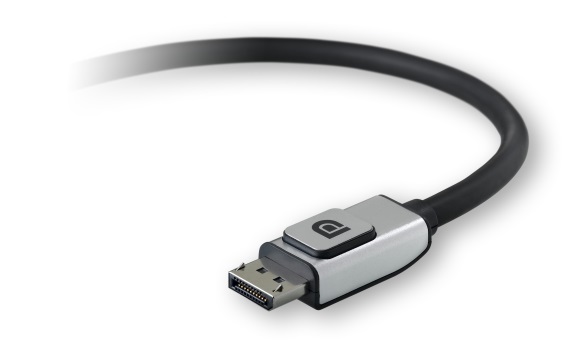
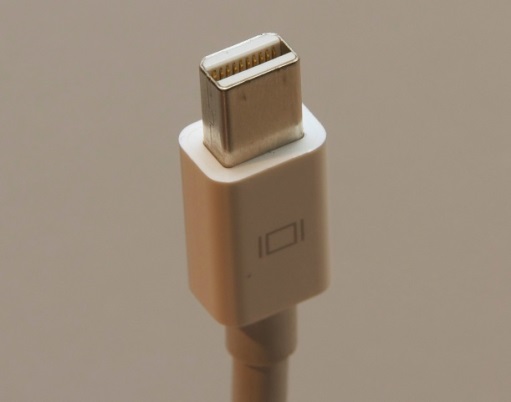
One thing you will need to consider in your cable purchase is the connector type on each end of the cable. There are two DisplayPort connector types. The standard DisplayPort connector (see image 1) is about the size of a USB connector, and this type is commonly used on DisplayPort-enabled PC monitors. The smaller mini DisplayPort connector (see image 2) is commonly used for the DisplayPort output on notebook PCs including Apple products. The mini DP connector is now also used for Thunderbolt that is widely used on Apple products. And you can connect any DisplayPort monitor to a Thunderbolt Source, using a standard DisplayPort cable, while achieving DisplayPort quality (Thunderbolt is backwards compatible with DisplayPort, and even includes support for Dual-Mode DP-to-HDMI and DP-to-DVI adaptors, and DP-to-VGA adaptors).
Image 1: Standard DisplayPort Connector
Image 2: Mini DisplayPort Connector
An important criterion for selecting a DisplayPort cable is to know which type of DisplayPort connector you need at each end. The other obvious criterion is cable length; they are generally available in lengths of 1 to 3 meters (up to about 10 feet).
As mentioned previously, it is important to avoid low quality DisplayPort cables to prevent unexpected video or audio problems, and sometimes even system power-up problems. Always buy cables from a reputable computer system or accessory brand. Or safer yet, buy a cable that is DisplayPort certified. DisplayPort certified cables are listed here.
Recently VESA has experienced quite a few complaints regarding troublesome DisplayPort operation that ended up being caused by improperly made DisplayPort cables. These “bad” DisplayPort cables are generally limited to non-DisplayPort certified cables, or off-brand cables. To further investigate this trend in the DisplayPort cable market, VESA purchased a number of non-certified, off-brand cables and found that an alarmingly high number of these were configured improperly and would likely not support all system configurations. None of these cables would have passed the DisplayPort certification test, moreover some of these cables could potentially damage a PC, laptop, or monitor. We have not seen problems with the cables supplied by major computer brands, or major computer accessory brands, nor have we seen any problems with any of the cables that have been DisplayPort certified.
The upcoming USB cable design is reversible, has no right-side-up or upside-down problems, and will click when you plug it in. Expect the new design on the market as soon as this year.
The USB Type-C connector, which governs ports and cables, will be smaller than typical USB ports on PCs but bigger than those on mobile phones.
So now we know what the next-gen USB cable will look like.
The new design, called USB Type-C, is designed to replace today's multitude of cables and fix a number of their shortcomings. Type-C USB jacks will be small enough for mobile phones, the cable will be reversible end-to-end so it doesn't matter which end you attach to your computer and which to your digital camera, and as with Apple's Lightning connector there will be no upside-down when it's time to actually plug the cable in.
The USB Implementers Forum, which oversees the Universal Serial Bus specification, announced its plans for a new USB cable and port in December but hadn't settled on the exact physical design of the connector. Now it's done, and the new cables could arrive in months, the USB IF said Wednesday at the Intel Developer Forum conference in Shenzhen, China.
"The specification is anticipated to be completed in July 2014. We could see products with the new cable by end of year," the USB IF told CNET.
Expect new USB Type-C ports to live side by side with old-style ports for awhile.
Type-C cures all these ills, the USB IF argues
But along with the difficulties of dragging the entire PC, phone, tablet, and gadget ecosystem into the future, USB Type-C faces another challenge from the USB IF itself: a new attempt to encourage wireless USB data transfer after last decade's effort flopped. Cables still have advantages, though, including the ability to charge and power devices and fast data-transfer speeds. Although the new wireless USB in principle can reach into the gigabit-per-second range with 60GHz 802.11ad wireless networking, Type-C cables will support USB 3.1's 10Gbps rates.The USB prong itself measures 8.3x2.5mm, smaller than the plugs that fit into a PC's USB ports today but larger than the 6.85x1.8mm of the Micro-USB B-type those widely used in mobile phones. Cable supported cable lengths won't change.
Other attributes of the Type-C design, according to the USB-IF:
It'll make an audible click when plugged in correctly.
It's designed to accommodate future USB incarnations with higher data-transfer speeds.
It'll support USB's growing role in carrying power to operate and charge devices through the USB Power Delivery technology.
It's designed to be plugged and unplugged 10,000 times.
With so many USB devices in the market today, don't expect an immediate transition to the new cable. It's likely PCs will include new and old port styles side by side, and that people will have use for cables and adapters that bridge the old and new styles.
USB Type-C will replace all these current different types of USB cables.
Look around your house and chances are you that have a least a few devices equipped with Universal Serial Bus (USB) cables. On average, some 3 billion USB ports are shipped each year, by far the most successful type of peripheral connection.
In years, though, USB is getting competition and it now trails behind the new Thunderbolt standard both in speed and ease of use. This is the gap that the latest in USB development, the USB Type-C,finalized just earlier this month, intends to fill.
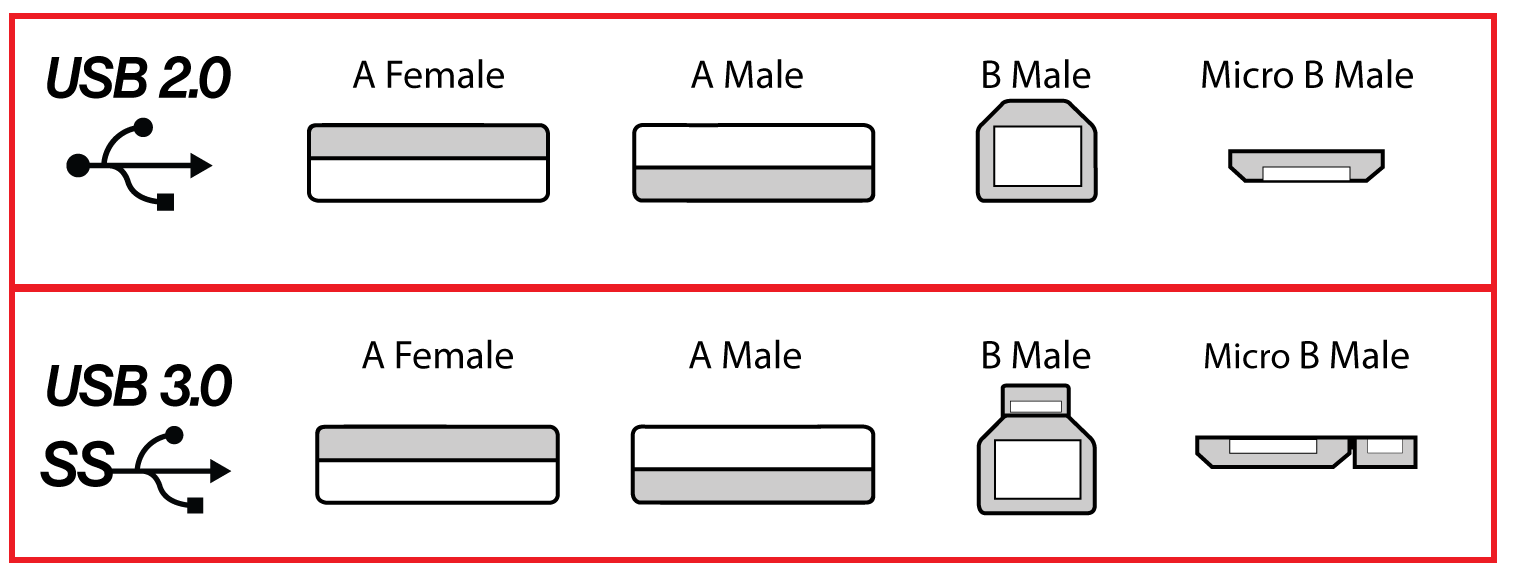
Before you can understand USB Type-C, however, you need to know the difference between USB Type-A and Type-B, and tell between the various versions of the USB standard. Generally, version refers to the speed and functionality of the USB cable, while the USB Type refers to the physical shape and the wiring of the ports and plugs.
USB Type-A
Also known as USB Standard-A, USB Type-A is the original design for the USB standard with a flat and rectangular shape.
On a typical USB cable, the Type A connector, aka the A-male connector, is the end that goes into a host, such as a computer. And on a host, the USB port (or receptacle) where the Type A-male goes into, is called an A-female port. Type-A ports are mostly in host devices, including desktop computers,laptops, game consoles, media players and so on. There are very few peripheral devices that use a Type-A port.
Different USB versions including USB 1.1, USB 2.0, USB 3.0 (more on versions below) currently share the same USB Type-A design. That means a Type-A connector is always compatible with a Type-A port event if the device and host use different USB versions. For example, a USB 3.0 external hard drive also works with a USB 2.0 port, and vice versa.
Similarly, small devices such as a mouse, keyboard, or network adapter that have hard-wired USB cables always use Type-A connectors. That's true also for things without cables, such as a thumb drive.
Though USB 3.0's connectors and ports have have more pins than those of USB 2.0 versions to deliver faster speed and higher power output, these pins are organized in a way that doesn't prevent them from physically working with the older version.
Also note that there are smaller Type-A plugs and connectors, including Mini Type-A and Micro Type-A, but there are very few devices that use these designs.
USB Type-B
Typically, the Type-B connector is the other end of a standard USB cable that plugs into peripheral device (such as a printer, a phone, or an external hard drive). It's also known as Type B-male. On the peripheral device, the USB port is called Type B-female.
Since the peripheral devices vary a great deal in shape and size, the Type-B connector and its respective port also come in many different designs. Up to now there have been five popular designs for the USB Type-B's plugs and connectors. And since the Type-A end of a USB cable remains the same, the Type-B end is used to determine the name of the cable itself. (Wikipedia has a great USB connector mating matrix that you can consult.)
The original standard (Standard-B): This design was first made for USB 1.1 and is also used in USB 2.0. It's mostly for connecting large peripheral devices, such as printers or scanners to a computer.
Mini-USB (or Mini-B USB): Significantly smaller, the Mini-USB Type-B ports are found in older portable devices, such as digital cameras, smartphones, and older portable drives. This design is becoming obsolete.
Micro-USB (or Micro-B USB): Slightly smaller than Mini-USB, the Micro-USB Type-B port is currently the most popular USB port design for latest smartphones and tablets.
Micro-USB 3.0 (or Micro-B USB 3.0): This is the widest design and mostly used for USB 3.0 portable drives. Most of the time, the Type-A end of the cable is blue.
Standard-B USB 3.0: This design is very similar to the Standard-B, however, it's designed to handle USB 3.0 speed. Most of the time, both ends of the cable are blue.
Note that there's also another, less popular, USB 3.0 Powered-B plug and connector. This design has two additional pins to provide extra power to the peripheral device. Also, there's relatively a rare Micro Type-AB port that allows the device to work as either a host or a peripheral device.
Proprietary USB
Not all devices use standard USB cables mentioned above. Instead, some of them use a proprietary design in the place of the Type-B plug and connector. The most famous example of these devices are the iPhone and the iPad, where either a 30-pin or lightning connector takes place of the Type-B end. The Type-A end, however, is still the standard size.
USB REVISIONS
Top speed
Max power output
Power direction
Cable configuration
Availability
USB 1.1
12Mbps
2.5V, 500mA
Host to peripheral
Type-A to Type-B
1998
USB 2.0
480Mbps
2.5V, 1.8A
Host to peripheral
Type-A to Type-B
2000
USB 3.0
5Gbps
5V, 1.8A
Host to peripheral
Type-A to Type-B
2008
USB 3.1
10Gbps
20V, 5A
Bi-directional
Type-C both ends, reversible plug orientation
2015
USB versions
USB 1.1: Released in August 1998, this is the first USB version to be widely adopted (the original version 1.0 never made it into consumer products). It has a top speed of 12Mbps (though in many cases only performs at 1.2Mbps). It's largely obsolete.
USB 2.0: Released in April 2000, it has a max speed of 480Mbps in Hi-Speed mode, or 12Mbps in Full-Speed mode. It currently has the max power out put of 2.5V, 1.8A and is backward-compatible with USB 1.1.
USB 3.0: Released in November 2008, USB 3.0 has the top speed of 5Gbps in SuperSpeed mode. A USB 3.0 port (and connector) is usually colored blue. USB 3.0 is backward-compatible with USB 2.0 but its port can deliver up to 5V, 1.8A of power.
USB 3.1: Released in July 26, 2013, USB 3.1 doubles the speed of USB 3.0 to 10Gbps (now called SuperSpeed+ or SuperSpeed USB 10 Gbps), making it as fast as the original Thunderbolt standard. USB 3.1 is backward-compatible with USB 3.0 and USB 2.0. USB 3.1 has three power profiles (according toUSB Power Delivery Specification), and allows larger devices to draw power from a host: up to 2A at 5V (for a power consumption of up to 10W), and optionally up to 5A at either 12V (60W) or 20V (100W). The first USB 3.1 products are expected to be available next year, and will mostly use USB Type-C design.
USB Type-C
Physically, the Type-C port and connector is about the same size as that of the Micro-B USB mentioned above. A Type-C port measure just 8.4mm by 2.6mm. This means it's small enough to work for even the smallest peripheral devices. With Type-C, a USB cable's both ends will be the same, allowing for reversible plug orientation. You also don't need to worry about plugging it in upside down.
Set to be available next year, Type-C USB will support USB 3.1 with the top speed of 10Gbps and has much high power output of up to 20V(100W) and 5A. Considering most 15-inch notebook computers require just around 60W of power, this means in the future laptop computers can be charged the waytablets and smartphones are now, via their little USB port.
Type-C USB also allows for bi-directional power, so apart from charging the peripheral device, when applicable, a peripheral device could also charge a host device. All this means you can do away with an array of proprietary power adapters and USB cables, and move to a single robust and tiny solution that works for all devices. Type-C USB will significantly cut down the a amount of wires currently needed to make devices work.
CHECK OUT THE NEW REVERSIBLE USB (PICTUR...SEE FULL GALLERY
Backward-compatible but adapters required
Type-C USB and USB 3.1 are backward-compatible with USB 3.0 and USB 2.0. However, with Type-C USB, the Type-A ports and plugs are no longer included. This means before Type-C becomes universal, existing host and peripheral devices will need an adapter to work with other Type-C-enabled devices.
This is the fist time adapters are required with USB, and likely the only time, at least for the the foreseeable future. USB Implementers Forum, the group responsible for the development of USB, says that Type-C USB is designed to be future-proof, meaning the design will be used for future and faster USB versions.
It will take a few years for Type-C become as popular as the current Type-A, but when it does it will simplify the way we work with devices. There will be just one tiny cable needed for any device, for both data and power connections.
 Splitters are essentially complete opposites from switches. They are capable of the same matrixes, but an HDMI switch is able to use multiple source devices to one display. This is the ideal solution for those who lack the amount of HDMI inputs they need to use on one TV. It is possible to use up to 8 different HDMI sources to 1 HDTV with some HDMI switches. Obviously, you now know that an HDMI splitter can multiply a single HDMI source to multiple displays. Currently, HDMI switches are not as heavy on the wallet as HDMI splitters. HDMI splitters cost more because the technology used is more advanced. Nevertheless, both types of digital devices are well worth the buy in order to suit your needs.